If you’ve ever tapped a key card to open an office door, waved a transit pass at a turnstile, or paid with a contactless bank card, you’ve used RFID technology. RFID cards are everywhere, yet most people have never stopped to ask how they work. This article explains what RFID cards are, how they function, the main types, and how to use them wisely.
What Does RFID Stand For?
RFID stands for Radio-Frequency Identification. It is a wireless technology that uses radio waves to identify and exchange data with a tagged object, in this case a card, without any physical contact or line of sight. An RFID card is simply a card with a tiny chip and antenna embedded inside, holding a small amount of data such as a unique ID number.
How Do RFID Cards Work?
An RFID system has three basic parts:
- The tag (the card): a microchip connected to a thin copper or aluminum antenna, sealed inside plastic.
- The reader: a device that emits a radio signal and listens for a reply.
- The back-end system: software or a database that decides what to do with the ID the reader receives, such as unlocking a door or deducting a fare.
When you bring the card near a reader, the reader’s radio field energizes the card’s antenna. The chip wakes up, uses that tiny burst of energy to transmit its stored data back to the reader, and the system checks whether that ID is allowed. The whole exchange takes a fraction of a second.
Passive vs. Active RFID Cards
Passive RFID cards have no battery. They draw power from the reader’s signal, which keeps them cheap, thin, and long-lasting. Almost every access card, hotel key, and payment card is passive. Read range is short, from a few centimeters to about a meter, depending on frequency.
Active RFID tags contain their own battery and broadcast a signal on their own. They can be read from tens or even hundreds of meters away, which makes them suited to tracking shipping containers, vehicles, and equipment. They are bulkier and costlier, so they are rarely used as ordinary cards.
RFID Frequency Types
| Type | Frequency | Typical range | Common uses |
|---|---|---|---|
| Low Frequency (LF) | 125–134 kHz | Up to ~10 cm | Older door access cards, animal ID |
| High Frequency (HF) | 13.56 MHz | Up to ~1 m | Transit cards, hotel keys, payment cards, library cards |
| Ultra-High Frequency (UHF) | 860–960 MHz | Several meters | Inventory, toll tags, supply chain |
NFC (Near Field Communication) is a specialized subset of high-frequency RFID with a very short range, which is why your phone can act as a contactless card.
Common Uses of RFID Cards
- Access control: office buildings, gyms, apartment complexes, and hotel rooms.
- Public transit: tap-to-ride passes in cities around the world.
- Contactless payments: many credit and debit cards use RFID or NFC chips.
- Identification: student IDs, employee badges, and some passports and driver’s licenses.
- Libraries, events, and ticketing: fast check-in and check-out without scanning barcodes.
- Loyalty and membership programs: quick recognition at the point of sale.
Advantages of RFID Cards
- Fast and convenient: a tap is quicker than inserting a card or typing a code.
- Durable: with no magnetic stripe to wear out, cards last for years.
- Hands-free reading: no precise alignment or line of sight needed.
- Easy to manage: access can be granted, changed, or revoked centrally.
- Low cost: passive cards are inexpensive to produce at scale.
Security and Privacy Considerations
Basic RFID cards, especially older low-frequency ones, can be cloned with inexpensive equipment because they transmit a fixed ID with no encryption. Modern cards use encryption and authentication to make this far harder. To stay safe:
- Prefer modern, encrypted card technologies for sensitive access.
- Report lost cards immediately so they can be deactivated.
- Consider an RFID-blocking sleeve or wallet if you carry contactless payment cards and want extra peace of mind.
- Never lend or duplicate access cards without authorization.
In practice, the risk of someone stealing data from a contactless payment card in everyday life is low, since payment systems add layers of protection such as one-time transaction codes.
AlphaScan RFID: An RFID Reader for School Cafeterias
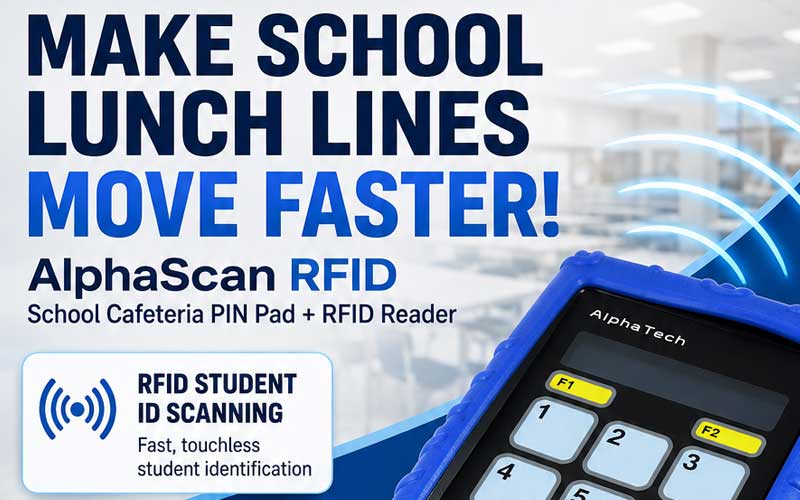
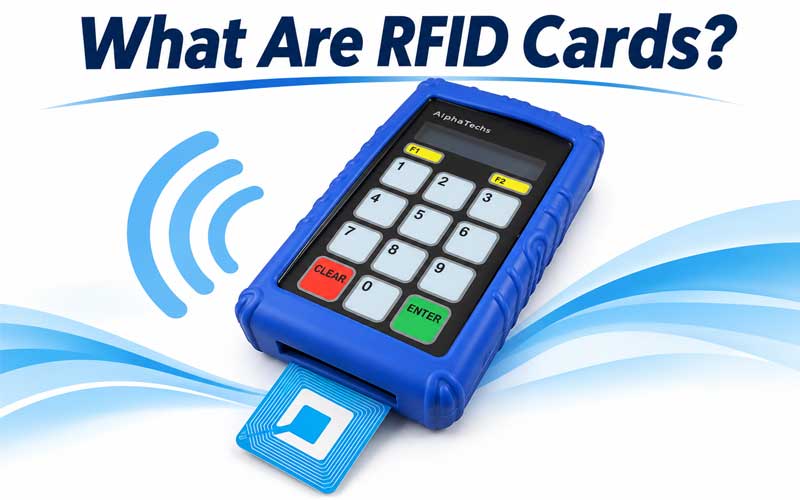
AlphaScan RFID is a school cafeteria pin pad with a built-in RFID reader, designed so K-12 students can scan their IDs quickly and keep lunch lines moving. It works with all school lunch POS software and comes in two versions: a Bluetooth model (RFID-BT) and a USB model (RFID-USB). Each unit ships with a free anti-shock cover and a 3-year warranty, and it also includes a built-in barcode scanner for standard student ID cards. The reader supports two sets of compatible RFID cards. Option 1 covers 13.56 MHz ISO14443 Type A cards, including Mifare Ultralight, NTAG203/NTAG213, Mifare S50/S70, DESFire, and the FM1208 CPU card. Option 2 covers standard 13.56 MHz Mifare cards (S50, S70, FM11RF08) together with 125 kHz EM4100 and TK4100 cards, so schools can use both high-frequency and low-frequency tags with one reader.
FAQs
Q1. Is an RFID card the same as an NFC card? Not exactly. NFC is a type of high-frequency RFID that works only at very short distances, usually a few centimeters. All NFC cards are RFID, but not all RFID cards are NFC.
Q2. Do RFID cards need a battery? Most don’t. Passive RFID cards are powered by the radio field from the reader. Only active RFID tags contain a battery.
Q3. How far away can an RFID card be read? It depends on the type. Common access and payment cards work within a few centimeters up to about a meter, while UHF tags can be read from several meters away.
Q4. Can RFID cards be cloned or hacked? Some basic, unencrypted cards can be copied with cheap tools. Cards with modern encryption are much more resistant. Using secure card types and deactivating lost cards greatly reduces the risk.
Q5. Can an RFID card be reused or reprogrammed? It depends on the chip. Many cards store a fixed ID and can’t be changed, while others have rewritable memory that lets an administrator update the data, as with some transit and membership cards.