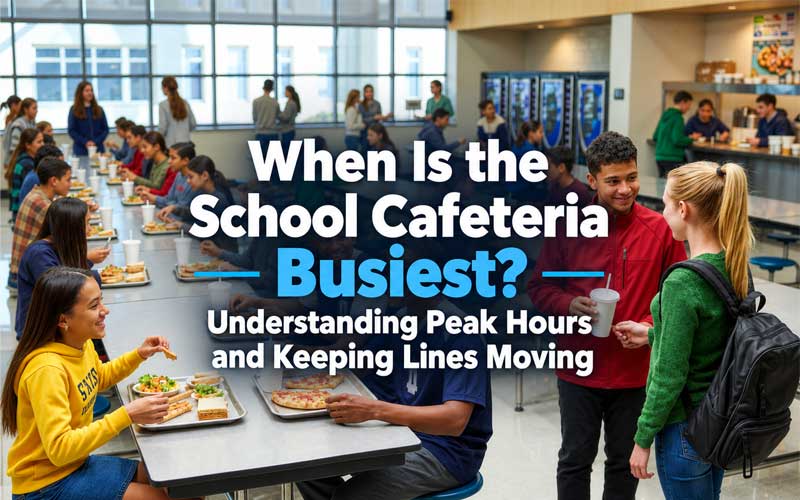
Anyone who has worked in a school cafeteria knows the feeling. The doors open, and within minutes a quiet room turns into a wall of hungry students with a limited window to eat. Understanding when the rush happens, and why, is the first step toward managing it.
The Lunch Rush: Why It Happens
School cafeterias run on a fixed schedule. Unlike a restaurant, where customers trickle in over several hours, a school cafeteria serves large groups in short, predictable bursts. Lunch periods are often only 25 to 40 minutes long, and students must get through the line, pay, find a seat, and eat within that time.
The busiest stretch is almost always the first 10 to 15 minutes of each lunch period. Students arrive together from the same class, and everyone wants to be served at once. Lines are longest right as the bell rings and thin out toward the end of the period.
Typical Peak Hours by School Level
Elementary schools usually run lunch between 10:30 a.m. and 12:30 p.m., often in several short shifts by grade level. Younger students move more slowly, so even smaller groups can create bottlenecks at the register.
Middle schools commonly schedule two or three lunch periods between 11:00 a.m. and 1:00 p.m. Because these are large groups with a lot of social pressure to sit with friends, students tend to rush the line.
High schools often have the most complicated schedules, with three or four lunch periods between roughly 10:45 a.m. and 1:15 p.m. The middle periods, typically around 11:45 a.m. to 12:30 p.m., tend to be the largest and most crowded.
Other Busy Times Worth Planning For
Lunch is not the only rush. Many schools also see heavy traffic at:
- Breakfast: The 15 to 30 minutes before first bell, especially in schools with free or reduced-price breakfast programs.
- À la carte and snack service: Students who buy extras often create a second wave of traffic at the register.
- Special menu days: Pizza day, taco day, or other student favorites can push participation well above average.
- Mondays and Fridays: Attendance patterns and menu popularity can shift daily volume.
- After-school programs and events: Some schools serve snacks or suppers that create another short peak.
What Causes Slowdowns at the Register
Even when food service is efficient, the checkout point is often where lines back up. Common causes include:
- Students forgetting or fumbling their ID numbers
- Manual entry of student accounts by cashiers
- Handling cash and making change
- Confusion over free, reduced-price, and paid meal status
- Long waits to look up accounts when a student has no card
Each delay may only cost a few seconds, but across hundreds of students in a short lunch window, those seconds add up to long lines and less time to eat.
Tips for Managing Peak Hours
- Stagger service points. Open multiple lines or serving stations so students spread out instead of clustering.
- Offer grab-and-go options. Pre-packaged meals and salads let students bypass the main line.
- Look at your data. Track how many students pass through each register in five-minute increments to find your true peak.
- Prepare for popular menu days. Increase staffing and stock on days when participation typically spikes.
- Streamline checkout. Since payment is the most common bottleneck, this is often where the biggest gains are found.
Choosing the right PIN pad for your school cafeteria is a multifaceted decision that requires careful consideration of various factors, including workflow, technology options, cost, durability, and accessibility. By taking the time to evaluate these elements and consulting with experts, schools can select a solution that enhances efficiency and provides a positive experience for students.
Whether your focus is on speeding up lunch lines, modernizing with RFID technology, or ensuring accessibility for all students, the right PIN pad can make a significant difference in your cafeteria operations.
How Alphatechs USA Helps School Lunch Lines Move Faster
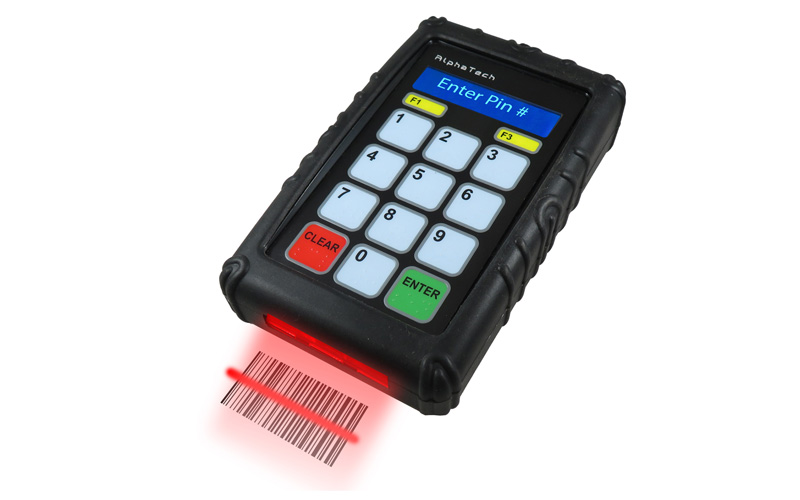
Checkout speed is where technology can make the biggest difference, and that is where Alphatechs USA comes in. Alphatechs USA’s PIN pads and scanners are designed to help school cafeterias serve more students in less time. Students can enter their PIN or scan their ID quickly, which cuts down on manual lookups and cashier errors. Faster, more accurate transactions mean shorter lines, less time waiting, and more time for students to sit down and eat. For food service teams, that also means less stress during the busiest minutes of the day. Whether you run a small elementary school or a large high school, reliable point-of-sale hardware can turn a chaotic rush into a smooth, predictable flow.
Our best-selling pin pad AlphaPad, scanner combos AlphaScan 1D, AlphaScan QR Express and AlphaScan RFID are compatible with all school lunch POS systems. Each unit comes with a free complementary anti-shock cover designed to keep your devices safe at all time. Stand-alone readers are also available including orbital scanners, USB handheld barcode scanners as well as Bluetooth handheld barcode scanners.
For any school cafeteria POS scanner question, feel free to contact us.
Frequently Asked Questions
What time is the school cafeteria busiest?
Most cafeterias are busiest during the first 10 to 15 minutes of each lunch period, typically between 11:00 a.m. and 1:00 p.m. In high schools, the middle lunch periods are often the most crowded.
How long do students usually have to eat lunch?
Lunch periods generally run 25 to 40 minutes, but the time students actually have to eat is shorter once they wait in line and pay.
Why are school lunch lines so long?
Large numbers of students arrive at once, and checkout is often the slowest step. Manual account lookups, cash handling, and forgotten ID numbers all add to the delay.
How can schools reduce cafeteria wait times?
Schools can add serving stations, stagger lunch periods, offer grab-and-go items, and use faster checkout tools such as PIN pads and scanners.
Do PIN pads and scanners really make lunch lines faster?
Yes. By speeding up student identification and reducing manual entry, they shorten the time each student spends at the register, which adds up quickly during a rush.
Are school cafeterias busier at breakfast or lunch?
Lunch is almost always busier because nearly all students eat at school. Breakfast volume varies depending on the school’s program and how many students participate.
What can cafeteria staff do to prepare for peak hours?
Review past participation data, schedule extra staff for the busiest periods, prep popular items early, and make sure checkout equipment is working before the first bell.