
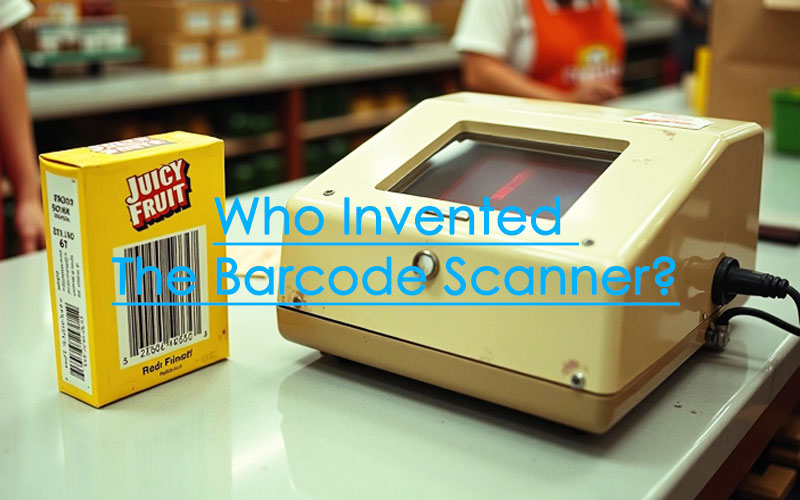
Most people don’t think about who invented barcode scanner technology when they hear that beep at checkout, but the answer involves a 25-year trip. A pack of Wrigley’s Juicy Fruit gum became the first product scanned at Marsh supermarket in Troy, Ohio, on June 26, 1974, at 8:01 a.m.. That same pack now sits in the Smithsonian Institution’s National Museum of American History.
The history of barcodes stretches back to 1949 when Bernard Silver and Joseph Woodland first envisioned the technology. We’ll explore when barcodes were invented and trace the progress from bulls-eye designs to UPC codes. We’ll also get into how George Laurer’s winning design became the retail standard we use today.
The Inventors Behind the Barcode Scanner: Woodland, Silver, and Collins
Bernard Silver and Joseph Woodland: The 1949 Patent
The story begins when a Philadelphia grocery store president approached Drexel Institute of Technology in 1948 and asked for a system to read product information at checkout. Bernard Silver, a graduate student, overheard the conversation and mentioned it to his friend Norman Joseph Woodland. The dean refused to let them tackle the problem, but Woodland felt such passion about it that he quit graduate school during winter 1948 and moved to his grandfather’s Miami Beach apartment.
Woodland sat in a beach chair during January 1949 and drew his fingers through the sand. He recalled Morse code from his Boy Scout days. He extended dots and dashes downward into parallel lines and created the first barcode concept. Back in Philadelphia, Silver and Woodland filed their patent on October 20, 1949. The patent was granted on October 7, 1952 [1] and featured both linear and bulls-eye designs that could be scanned from any direction.
Their prototype used a 500-watt incandescent bulb and an oscilloscope, but it was judged 20 years ahead of its time. The pair sold their patent to Philco for $15,000 [2], the only money they ever made from their invention. Silver died in 1963 at age 38 and never saw his creation become common.
David J. Collins: The Railroad System Pioneer
David Collins joined Sylvania Electric Products during 1959 and developed KarTrak, the first commercial linear barcode system for tracking railroad cars. The system used blue, red, black, and white reflective stripes that encoded a six-digit company identifier and a four-digit car number. Ninety-five percent of rail cars carried a KarTrak code at its peak [2].
Collins recognized the technology’s broader potential. He founded Computer Identics Corporation [2] during 1961 to develop laser-based scanners. His company sold the world’s first commercial laser scanner to General Motors in 1969 [2], which tracked car components on a Pontiac assembly line. The United States Congress issued him a Certificate of Appreciation during 2011 and recognized him as “the father of the bar code industry” [2].
George Laurer: The UPC Code Designer
Retailers challenged computer companies in 1970 to create a standard checkout system. IBM engineer George Laurer stepped up. He rejected the circular bulls-eye design and identified its fatal flaw: it smudged during printing. Instead, he developed a rectangular barcode with vertical lines that satisfied all requirements and could be printed on existing equipment while remaining readable from any direction.
The Universal Product Code was born on April 1, 1973 [3] and consisted of 30 black bars scannable by lasers. Laurer’s practical design overcame the skepticism and became the retail standard still used today.
When Were Barcodes Invented? The Technology Evolution from 1949 to 1974
The Bulls-Eye Design: First Barcode Concept (1949-1952)
Woodland’s original concept featured concentric circles resembling a bulls-eye target. This design solved a critical problem: orientation. A scanning beam would intersect the circular pattern somewhere, no matter how a product was rotated [4]. The bulls-eye could be read from any angle with accuracy [2].
The 1952 patent described both linear and bulls-eye printing patterns. It also covered mechanical and electronic systems needed to read the code [2]. Their crude prototype required a 500-watt incandescent bulb and used an oscilloscope to read the code [5]. The whole apparatus was desk-sized [6]. Testing at Kroger’s Kenwood Plaza store in Cincinnati showed the bulls-eye code delivered superior sales figures in 1972 [6].
The Laser Breakthrough That Changed Everything (1960)
Theodore Maiman at Hughes Research Laboratories created the first working laser using a ruby crystal. He achieved this breakthrough on July 16, 1960 [7]. The ruby laser produced a pulsed beam of red light with a wavelength of 694.3 nanometers [7]. The laser was described as “a solution looking for a problem” at the time it was first reported [3].
Computer Identics Corporation replaced incandescent light bulbs with helium-neon lasers and incorporated mirrors. Scanners could now locate barcodes up to a meter away [2]. The process became simpler and more reliable. Damaged labels could be handled with ease [2].
From Color Stripes to Black-and-White Lines
KarTrak used blue and orange vertical stripes on metal plates for railroad tracking [5]. Collins recognized that black-and-white versions would work better for other industries [2]. The move occurred because black-and-white offered better contrast and simpler printing requirements.
Computer Advancements Made Scanning Practical
Barcoding was first used in commerce in 1966 [8]. Logicon Inc. developed the Universal Grocery Products Identification Code by 1970 [8]. Affordable computers and microprocessors made Woodland’s 1949 vision practical for everyday retail use.
The 1974 Beep: First Barcode Scanner in Retail History
June 26, 1974: The Wrigley’s Gum Moment
Sharon Buchanan arrived for her shift at Marsh Supermarket without knowing she was about to make history [9]. Clyde Dawson, Marsh’s Director of Research and Development, handed her a 10-pack of Wrigley’s Juicy Fruit gum from his shopping cart at 8:01 a.m. [10]. The scanner emitted a beep. 67 cents appeared on the register [11].
Dawson’s selection wasn’t random. He chose gum to prove critics wrong who argued barcodes couldn’t be printed on small, inexpensive items [4]. The price showed 67 cents because Marsh offered a 2-cent discount on Wrigley’s standard 69-cent price [10]. That original pack now sits at the Smithsonian National Museum of American History [12].
Why IBM’s UPC System Won Over RCA’s Bulls-Eye
The Symbol Selection Committee faced a deadline in March 1973 [13]. RCA’s bulls-eye design had proven itself at Kroger’s Kenwood Plaza store in Cincinnati in July 1972 and showed superior sales figures [14]. But the circular pattern had a fatal flaw: it smeared in the printing direction [14].
IBM submitted a last-minute rectangular proposal. The committee asked MIT scientists to review both systems [1]. They chose IBM’s linear barcode with about 90 percent confidence on March 30, 1973 [1].
The Marsh Supermarket in Troy, Ohio
NCR selected Troy due to its proximity to NCR headquarters in Dayton and their Cambridge research facility. Hobart Corporation headquarters was also in Troy [10]. The location represented a typical American grocery store [10].
How the First Retail Scanner Worked
The system combined an NCR 255 computerized register with a Spectra-Physics Model A scanner [12]. A helium-neon laser projected a beam onto a rotating mirror, then through a glass plate on the top surface [12]. Reflected light from the barcode reached a diode. The NCR register matched it against stored database information [12]. Only two original Spectra-Physics Model-A scanners exist today [12].
History of Barcodes: From Grocery Stores to Global Standard
Why It Took Until the 1980s to Gain Wide Adoption
The Wrigley’s gum scan didn’t trigger immediate success. Consumer backlash began almost instantly, with The Phil Donahue Show warning viewers about potential price manipulation in summer 1974 [15]. Installation costs reached $250,000 per store [15], and retailers hesitated without manufacturer adoption. Only 1 percent of U.S. grocery stores had installed barcode scanners by the end of the 1970s [15].
So adoption accelerated in the early 1980s. More than half of all U.S. grocery sales used barcodes by 1989 [15]. The United States Department of Defense adopted Code 39 for all products sold to the military in 1981 [2], which served as the catalyst for widespread industrial adoption.
Expansion Beyond Retail: Healthcare, Libraries, School Cafeterias and Airlines
The organization entered healthcare in 1995 with standards that improved supply chain efficiency [16]. The GS1 Data Matrix became vital for patient wristbands, medical devices, and pharmaceuticals in 2018 [16]. School cafeterias switched from pin pads to scanners to make school lunch lines move faster. Airlines adopted IATA-standard 2D barcodes on boarding passes in 2005 [2], with mobile boarding passes following in 2008 [2].
2D Barcodes and QR Codes: The Next Generation
QR codes emerged in the 1990s when Denso Wave Incorporated developed them for manufacturing [6]. They gained popularity in the second decade of the 2000s due to smartphone growth [2]. Unlike linear barcodes holding only product identifiers, 2D barcodes can store expiry dates, batch numbers, serial numbers, weight, and origin [17].
Modern Scanning Technology and What’s Coming Next
The industry works toward 2027 as the moment when point-of-sale systems should scan 2D codes [17]. GS1 Sunrise 2027 will help retailers upgrade scanning infrastructure over time [17]. Over 20 companies including Procter & Gamble, L’Oreal, and Nestlé signed statements calling for next-generation barcode adoption [18].
AlphaTechs USA offers a wide selection of innovative school lunch barcode scanners
Specifically created for US school cafeterias, our pin pads, 1D scanners and 1D/2D QR barcode scanners and RFID code readers are compatible with all school lunch POS systems. Each unit comes with a free complementary anti-shock cover designed to keep your devices safe at all time.
Stand-alone readers are also available including orbital scanners, USB handheld barcode scanners as well as Bluetooth handheld barcode scanners.
Our devices are compatible with all US school cafeteria POS systems.
For any school cafeteria scanner question, feel free to contact us.
References
[1] – https://www.smithsonianmag.com/innovation/history-bar-code-180956704/
[2] – https://en.wikipedia.org/wiki/Barcode
[3] – https://press.uchicago.edu/Misc/Chicago/284158_townes.html
[4] – https://barkoder.com/blog/from-beeps-to-understanding-the-evolution-of-the-barcode
[5] – https://tera-digital.com/blogs/barcodes/when-did-barcode-come-out?srsltid=AfmBOopgs2yXrvPe_EsOk2MVWbMvFhN7X1p6KSsQ0YhqGAh16zzdxlya
[6] – https://digital-link.com/news/what-are-next-gen-qr-codes/
[7] – https://www.linkedin.com/pulse/1960-dawn-laser-technology-its-revolutionary-impact-sushil-chavan-jbref
[8] – https://www.barcodesinc.com/articles/history.htm?srsltid=AfmBOoorWs3twjDU9793QKGNe0aFV_MHQ3nZi4gXgbkvtN8JWprIAi8U
[9] – https://www.tastingtable.com/1236964/why-the-worlds-first-scanned-barcode-was-on-a-pack-of-gum/
[10] – https://www.thislocallife.com/upc-anniversary-troy-ohio
[11] – https://www.wired.com/2008/06/june-26-1974-supermarket-scanner-rings-up-historic-pack-of-gum/
[12] – https://www.iterator.com.ua/en/useful-info/203-50-years-since-the-first-barcode-was-scanned-in-a-supermarket-on-june-26-1974?srsltid=AfmBOooDdyC3YeQ8KNh3qnLnPbjKee4UrQ9JeqhoZL9FOAStsA6qrbtZ
[13] – https://theconversation.com/how-we-almost-ended-up-with-a-bulls-eye-bar-code-219194
[14] – https://www.wosu.org/2024-06-25/50-years-ago-the-first-retail-barcode-was-scanned-at-an-ohio-grocery-store
[15] – https://slate.com/technology/2024/05/barcode-history-technology-controversy.html
[16] – https://kmsoft.co.uk/healthcare/50-years-of-gs1-how-the-barcode-improved-healthcare-patient-safety/
[17] – https://www.igd.com/commercial-insight/retail-analysis/channels/articles/the-future-of-barcodes-turning-every-product-into-an-intelligent-asset/72662
[18] – https://www.gs1us.org/industries-and-insights/media-center/press-releases/gs1-us-celebrates-50-year-barcode-scanniversary