Anyone who has stood in a school cafeteria during the lunch rush knows the challenge: hundreds of students, a narrow window of time, and a line that needs to move. The technology a cafeteria uses to identify students and process meal accounts has a direct impact on how smoothly that line flows — and on how much staff time gets eaten up dealing with holdups. That’s why more school nutrition programs are moving to pin pads equipped with RFID readers.
The Speed Advantage of RFID
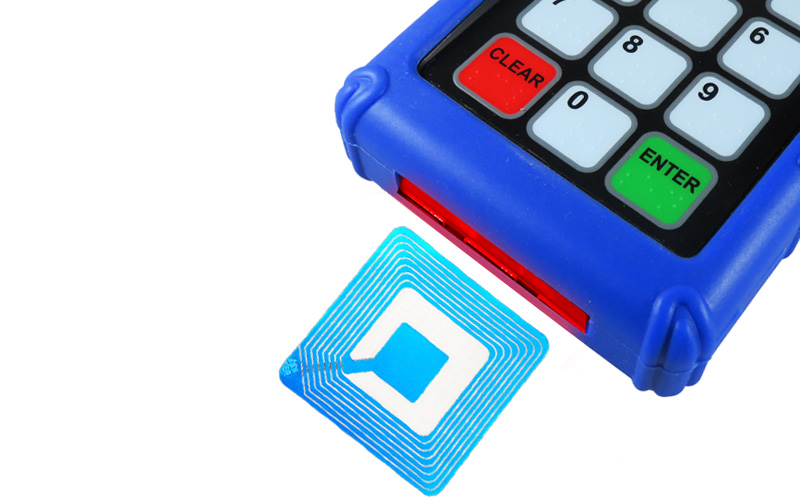
RFID (Radio Frequency Identification) works by using radio waves to pass data between a tag and a reader — no physical swipe, no barcode alignment, no typing required. A student simply taps or waves their ID near the reader, and the system pulls up their account in a fraction of a second. Because there’s no contact and no need to line up a card just right, RFID readers are consistently the fastest way to identify students at the point of sale. In a lunch period where every second in line adds up across hundreds of students, that speed difference translates directly into shorter lines and more time for kids to actually eat.
RFID also has practical benefits beyond speed. Because it’s contactless, there’s less wear and tear on ID cards and less time spent fumbling with a scanner. And unlike barcode systems, which strictly require a physical card, many RFID readers can even read tags embedded in phone cases or accessories, giving schools more flexibility for how they issue and manage student credentials.
Numeric Keypads: The Essential Backup
No matter how well-designed an ID system is, students will forget their cards. It happens every day, in every cafeteria, and a system with no fallback plan for a forgotten ID creates delays and frustration for both students and staff. This is where the “pin pad” half of the equation matters just as much as the RFID reader.
A built-in numeric keypad lets a student without their ID simply type in their student number to pull up their account, keeping the line moving without an awkward workaround or a trip to the office. The best cafeteria terminals are designed around this reality from the ground up — combining a fast, touchless RFID reader for the majority of students with a reliable manual entry option for the exceptions. That combination is what makes a pin pad/RFID reader a complete solution, rather than just a scanner that works until something goes wrong.
AlphaScan RFID: A Purpose-Built Solution for School Cafeterias
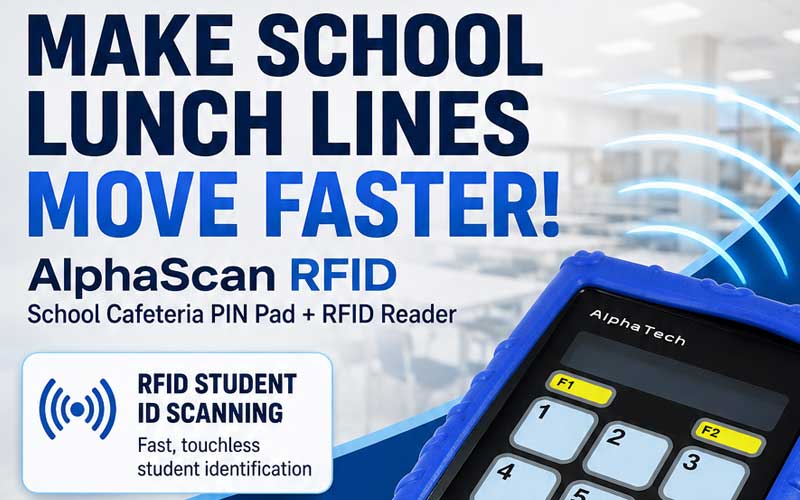
Among the devices built specifically for this use case, AlphaScan RFID from AlphaTechs USA stands out as a strong choice for school nutrition programs.
AlphaScan RFID pairs a fast RFID reader with a full numeric pin pad, so cafeteria staff always have a backup ready for students who’ve left their ID at home. A few features make it particularly well-suited to the school environment:
Built for speed and volume — a super-fast response rate keeps lunch lines moving, and the unit even supports running two lines at once.
Touchless operation — students simply tap their ID, with no physical contact needed.
Flexible ID reading — in addition to standard student RFID cards, the reader can pick up RFID codes off phones.
Rugged and practical design — tactile embossed keys with Braille, an adjustable audible beep, a programmable blue LCD display, and a complementary anti-shock protective cover included with every unit.
Compatibility — works with all US school lunch POS software, and is available in both Bluetooth and USB versions to fit different cafeteria setups. The Bluetooth version works across Windows, macOS, iPads, iPhones, Android devices, Chromebooks, and Microsoft Surface.
Assembled in the UA, shipped from AlphaTechs’ warehouse in Irvine, California, and FCC approved.
Backed by an Exceptional Warranty and Price Match Guarantee
What really sets AlphaScan RFID apart from other options on the market is the confidence AlphaTechs USA puts behind it. Every unit comes with a 3-year warranty from the date of purchase — a notably long commitment for hardware that’s going to see daily, high-volume use in a school cafeteria. On top of that, AlphaTechs backs the product with a price match guarantee, promising to match or beat the prices of key competitors, plus a 30-day money-back trial period so schools can try the device before fully committing.
For school nutrition directors evaluating point-of-sale hardware, that combination — fast, contactless RFID with a numeric keypad backup, rugged classroom-ready design, and a 3-year warranty with a price match guarantee — makes AlphaScan RFID one of the more compelling options available for keeping lunch lines short and cafeteria operations running smoothly.
FAQs
Q1. What happens if a student forgets their ID card? The built-in numeric pin pad lets students manually enter their student number to pull up their account, so the line keeps moving even without a physical card.
Q2. Does AlphaScan RFID work with our existing cafeteria software? Yes. AlphaScan RFID is compatible with all school lunch POS software, so schools can add it without needing to switch nutrition systems.
Q3. Which version should our school choose — Bluetooth or USB? The USB version connects directly via a standard 6-foot USB cable, which suits fixed cafeteria stations. The Bluetooth version runs on a rechargeable battery (roughly 25 hours of use per charge) and works across Windows, macOS, iPads, iPhones, Android devices, Chromebooks, and Microsoft Surface, offering more flexibility for mobile or multi-station setups.
Q4. Can it read RFID tags from something other than a student ID card? Yes, in addition to standard student RFID cards, the reader can also pick up RFID codes off phones.
Q5. What kind of support and protection comes with the purchase? Every unit ships with a complementary anti-shock protective cover, a 3-year warranty from the date of purchase, a 30-day money-back trial period, and AlphaTechs USA’s price match guarantee against key competitors.